
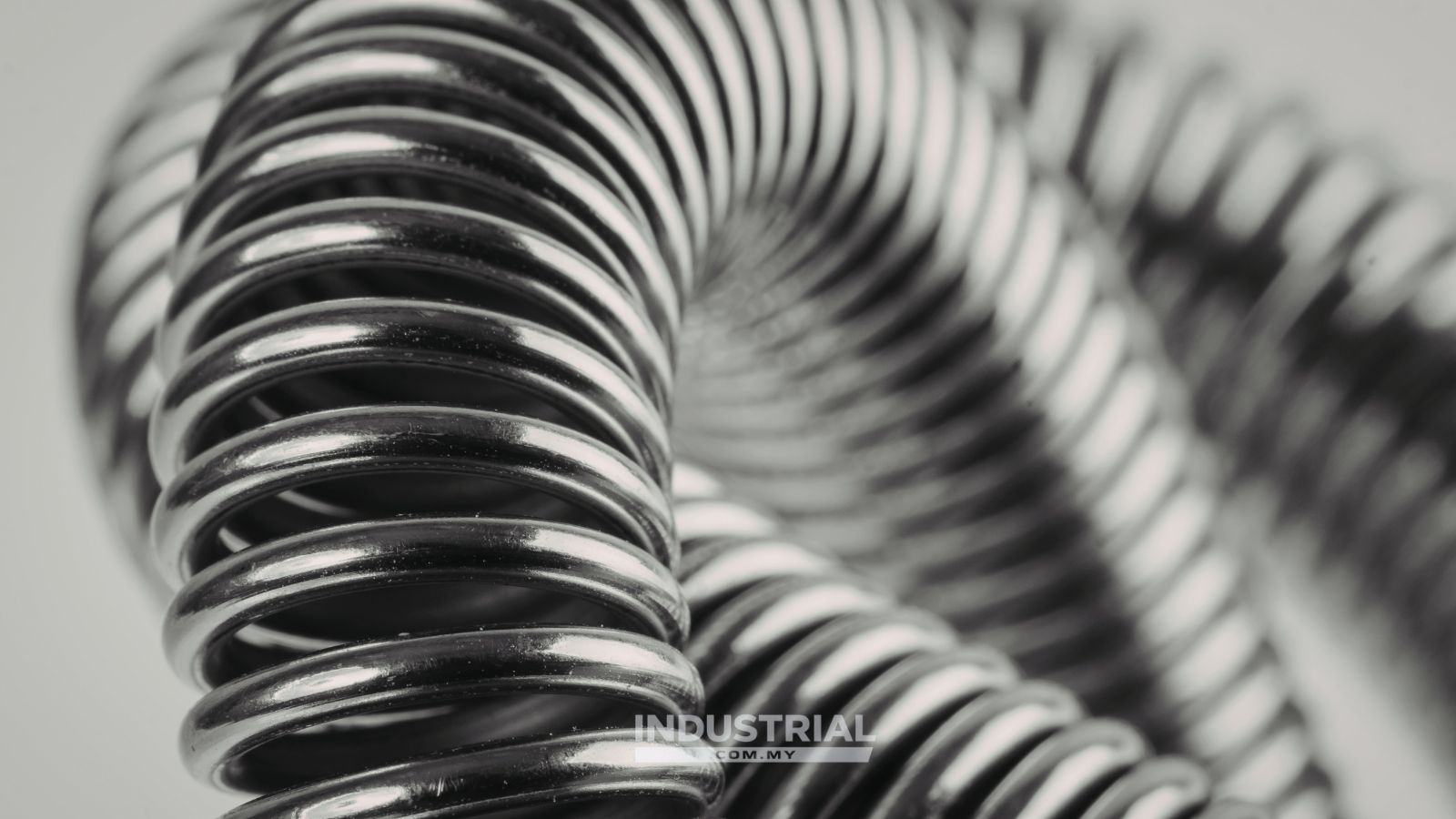
Springs are among the most fundamental mechanical components in engineering, present in virtually every category of machinery, vehicle, consumer product and industrial equipment. They store and release energy, apply controlled force, absorb shock and vibration, maintain contact between surfaces, and return mechanisms to their rest positions. Despite their ubiquity and mechanical importance, springs are frequently underspecified or incorrectly specified, leading to premature failure, product recall and costly warranty claims.
Malaysia’s manufacturing sector, spanning automotive components, electronic equipment, medical devices, agricultural machinery, consumer goods and a broad range of precision engineering products, has substantial and growing demand for locally manufactured springs that meet international quality standards. The ability to source springs from a domestic manufacturer with engineering capability, material traceability and quality management systems reduces lead times, simplifies supply chain management and provides a local engineering support resource for application-specific challenges.
The Main Types of Industrial Springs
Compression Springs
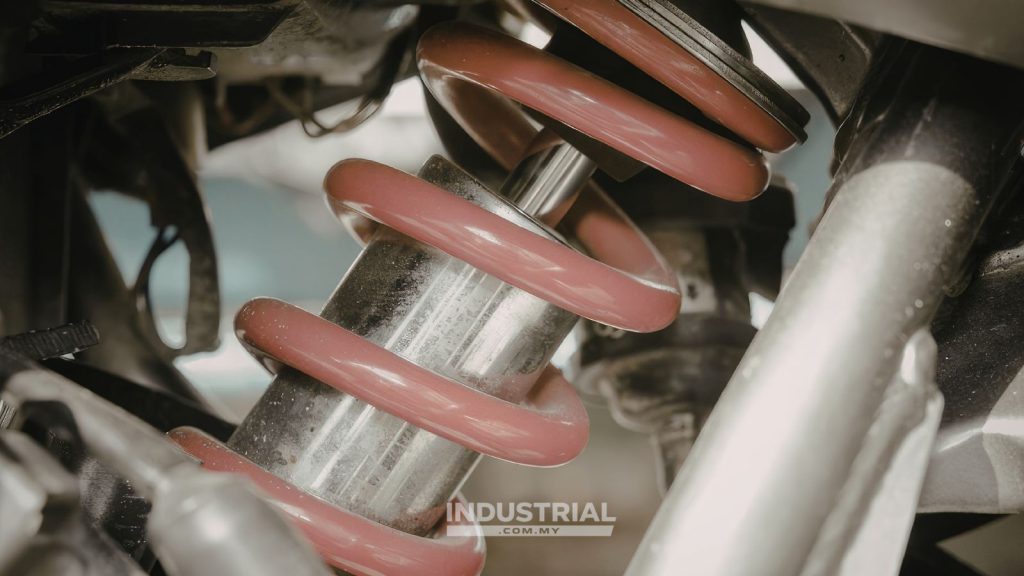
The most common spring type in industrial use. A compression spring is an open-coil helical spring that resists axial compressive loads, it pushes back when compressed and returns to its free length when the load is removed. Compression springs are found in automotive valve trains, suspension systems, die sets, pressure relief valves, pneumatic actuators, door hardware, safety devices and countless other applications.
Key design parameters for compression springs include: wire diameter, coil outer diameter, free length, solid length, spring rate (force per unit deflection, in N/mm), number of active coils, and end type (open, closed, ground, squared-and-ground). The spring rate, sometimes called stiffness, is the fundamental performance specification: too soft and the spring deflects too easily under operating loads; too stiff and it transmits shock rather than absorbing it.
Tension (Extension) Springs
Tension springs work in the opposite direction to compression springs, they resist stretching and store energy when extended. The coils are typically wound close together with an initial tension (pretension) that must be overcome before the spring begins to extend. Tension springs are used in garage door mechanisms, safety interlocks, return mechanisms, agricultural equipment and balance systems.
The hook design at each end of a tension spring is an important engineering detail, poorly designed hooks concentrate stress at the hook-body transition and are the most common point of fatigue failure in tension spring applications. High-fatigue applications should specify springs with German-standard loops or reduced-stress configurations rather than conventional side hooks.
Torsion Springs
A torsion spring stores energy when rotated about its central axis, generating a torque (twisting moment) rather than a linear force. Used in clothespins, mouse traps, door hinges, hinge mechanisms on machinery, and precision instruments. Torsion springs require careful specification of their coiling direction (left-hand or right-hand) relative to the direction of applied torque, and their installation condition, whether wound tight or partially open in the rest position.
Torsion Bars
A torsion bar is a straight, solid or hollow bar of spring-grade steel that acts as a torsional spring along its length. Used primarily in automotive front suspension systems, heavy vehicle suspension, and in the suspension of industrial machinery. Torsion bars are specified by material, cross-section dimensions, effective length and the angular deflection at design load, and their manufacturing requires precise straightness and heat treatment to achieve consistent spring rate and fatigue life.
Spring Materials: What Matters for Malaysian Conditions
Material selection significantly affects spring performance, fatigue life, corrosion resistance and operating temperature range. For Malaysian industrial applications, these are the primary material considerations:
| Material | Typical Application | Strengths | Limitations |
|---|---|---|---|
| Patented & cold-drawn steel wire (SWPA/SWPB) | General purpose compression and tension springs | Good mechanical properties, cost-effective | Susceptible to corrosion in humid or wet environments |
| Hard drawn wire (HD) | General commercial springs, lower stress applications | Lower cost, widely available | Lower fatigue strength than SWP; not for high-cycle applications |
| Oil-tempered wire (SWO/OT) | Automotive springs, valve springs, high-load applications | High fatigue strength, consistent properties | Less suitable for sharply bent ends; moderate corrosion resistance |
| Stainless steel (302/304/316) | Corrosive environments, food processing, outdoor, coastal | Excellent corrosion resistance | Lower tensile strength than carbon steel at same wire diameter; higher cost |
| Phosphor bronze | Electrical contact springs, marine, low-magnetic environments | Corrosion resistant, non-magnetic, conductive | Lower spring rate than steel; higher cost |
| Inconel / Superalloys | High-temperature applications (above 200°C), chemical plant | High-temperature performance, corrosion resistance | Very high cost; limited fabricability |
For Malaysian operating conditions, corrosion resistance deserves particular attention. Humid factory environments, coastal industrial sites, outdoor applications and any exposure to process chemicals all degrade uncoated carbon steel springs rapidly. Specifying stainless steel or applying appropriate surface treatments, zinc plating, hot-dip galvanising, phosphating with paint, or electroless nickel plating for precision applications, significantly extends spring service life in these conditions.
Specifying a Spring: The Information a Manufacturer Needs
A complete spring specification provides the manufacturer with sufficient information to design and manufacture the spring to your exact requirements. At minimum, a custom spring specification should include:
- Spring type, compression, tension, torsion or torsion bar
- Material, wire material and grade, or a request for the manufacturer’s recommendation based on operating conditions
- Key dimensions, wire diameter, coil diameter, free length (for compression/tension), angular position at load (for torsion)
- Performance requirement, spring rate (N/mm), or operating load at specified deflection, or torque at specified angle
- Operating conditions, temperature range, exposure to chemicals, liquids or corrosive atmosphere, cycle frequency
- End configuration, end types for compression springs, hook style for tension springs, coil direction for torsion springs
- Quantity and delivery requirement, manufacturing batch size and required delivery date
If you do not have a complete specification, for example, if you are replacing a spring from a failed component and need to reverse-engineer the original specification, provide as much dimensional information as you can measure directly (wire diameter, outer diameter, free length, number of coils) along with the operating load or deflection requirement, and an experienced spring manufacturer can develop the full specification from that starting point.
Industrial Spring Manufacturing in Malaysia
For Malaysian manufacturers, machinery OEMs, automotive suppliers, agricultural equipment makers and industrial maintenance operations requiring springs manufactured to precise specifications, in a range of wire sizes, materials and geometries, working with an established domestic spring manufacturer with quality management systems and material traceability provides supply chain reliability and local engineering support that imported springs cannot match.
Recommended Manufacturer: Solid Component Manufacturing Sdn Bhd
Solid Component Manufacturing S/B is a Malaysian company incorporated in 1983, manufacturing all types of Coil Spring, Compression Spring, Torsion Spring, Tension Spring and Torsion Bars for all industrial applications in Malaysia and the Asia Pacific region. With over four decades of spring manufacturing experience, they bring proven engineering capability and quality management to custom and standard spring requirements across a broad range of industries, from automotive and electronics to general industrial and agricultural applications.
Match the Material to the Environment, Every Time
Springs are one of those mechanical components that, when correctly specified and manufactured, function invisibly for the design life of the product. When incorrectly specified or manufactured from inappropriate materials, they cause failures that are often frustratingly difficult to diagnose because the spring itself may be physically intact at the point of failure, having simply lost its specified spring rate through fatigue relaxation rather than fracturing visibly.
Invest the engineering time in a complete, accurate specification. Match the material to the operating environment, particularly in Malaysia where humidity and chemical exposure accelerate corrosion in ways that temperate-climate spring designs often fail to account for. And work with a manufacturer who has the quality systems to verify that what they deliver matches what was specified. In a high-cycle application, the difference between a correctly and incorrectly specified spring is the difference between a component that performs for years and one that fails in months.
- Panduan Lengkap Memilih Kotak Pembungkusan Berkualiti untuk Perniagaan Makanan di Malaysia
- Industrial Magnets in Malaysia: A Complete Guide to Magnetic Products for Engineering and Manufacturing
- Bulk Material Handling & Pneumatic Conveying: A Complete Guide for Malaysian Industries
- Bagging and Filling Systems in Malaysia: Which Technology Is Right for Your Product?

