
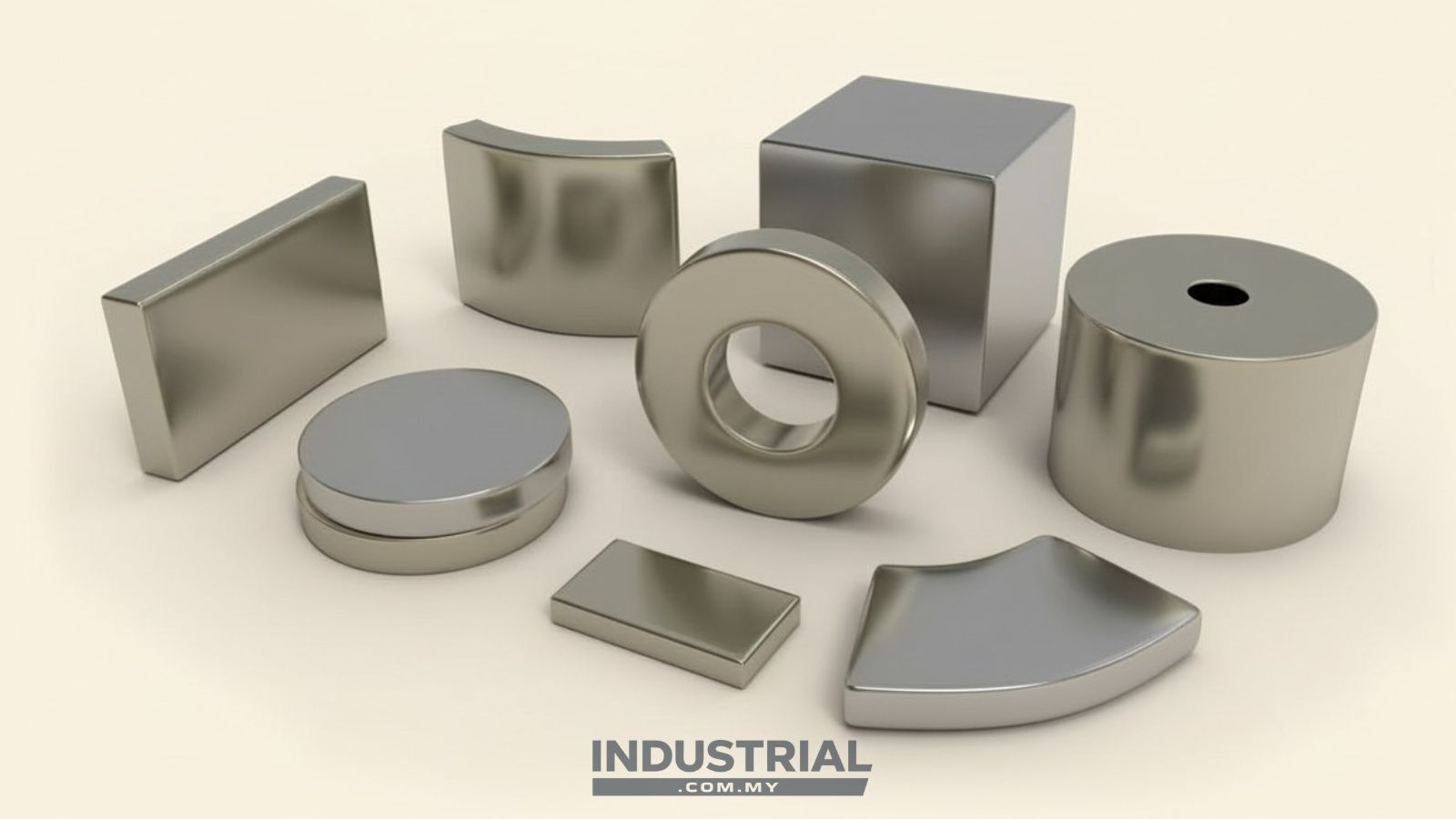
Industrial magnets operate quietly in the background of Malaysian manufacturing, on production lines in the food processing industry trapping metal contaminants before they reach the product, on conveyor systems separating ferrous materials from recycled waste streams, in machining operations holding workpieces precisely in position, in sensor systems detecting the position and speed of rotating components, and in the motors and actuators that drive the automation systems that are transforming Malaysian manufacturing.
This guide covers the main types of industrial magnets used in Malaysian engineering and manufacturing, what determines magnetic performance in real operating conditions, and how to specify the right magnetic product for your application.
Magnetic Materials: The Foundation of Performance
Not all magnets are made the same. The magnetic material determines field strength, temperature resistance, corrosion resistance and cost, and the right choice depends entirely on the specific operating conditions and performance requirements of the application.
| Magnet Type | Max Operating Temp | Corrosion Resistance | Relative Strength | Typical Applications |
|---|---|---|---|---|
| Neodymium (NdFeB) | 80–200°C (grade dependent) | Poor, must be coated | Highest available | Holding fixtures, sensors, motors, precision applications where maximum strength in minimum size is required |
| Samarium Cobalt (SmCo) | 250–350°C | Excellent | Very high | High-temperature motors, aerospace, medical devices, applications above 150°C where NdFeB degrades |
| Ceramic / Ferrite | 250°C | Excellent, no corrosion | Moderate | Magnetic separators, holding applications, sensors, water treatment, general industrial where cost matters |
| Alnico (Al-Ni-Co) | 450–540°C | Good | Moderate | High-temperature sensors, motors, instruments where high operating temperature is the primary constraint |
| Electromagnets | Depends on coil insulation | Depends on housing | Variable, adjustable | Lifting, holding, sorting, material handling where switchable or adjustable force is required |
For most Malaysian industrial applications, neodymium magnets offer the best combination of strength and size, a neodymium magnet is typically five to ten times stronger than a ceramic magnet of the same size. However, neodymium’s poor corrosion resistance (it oxidises rapidly without surface protection) and its degraded performance above 80°C make ceramic or samarium cobalt the better choice for wet, corrosive or high-temperature environments. In food processing applications, FDA-compliant coatings and materials are also a requirement for any magnet in direct contact with the product stream.
Key Industrial Magnet Applications in Malaysia
Magnetic Separation in Food Processing and Recycling
One of the highest-value applications of industrial magnets in Malaysia is the removal of ferrous metal contaminants from food products, animal feed, grain, powder and liquid streams. Metal contaminants introduced by agricultural harvesting machinery, milling equipment, conveyor wear and packaging processes can cause serious consumer safety issues, costly product recalls and regulatory action.
Magnetic separators for food processing are typically installed in-line, as drum magnets above conveyor belts, plate magnets above or below material chutes, or liquid line magnets in pipes carrying liquid or slurry products. The performance of a food-grade magnetic separator depends critically on the magnet strength (measured in Gauss at the collection surface, modern rare earth separators operate at 10,000 to 16,000+ Gauss), the gap between the magnet and the product stream, and the efficiency of the cleaning mechanism for removing accumulated metal from the separator face.
Workholding and Fixturing in Machining
Magnetic chucks and workholding systems are widely used in surface grinding, milling and electrical discharge machining (EDM) operations across Malaysian precision engineering workshops. A magnetic chuck provides fast, secure, distortion-free clamping of ferromagnetic workpieces, the workpiece is held by the magnetic field without clamping forces that would deflect thin or irregular parts. Permanent magnetic chucks, electro-permanent chucks (which can be switched off for part removal but hold safely during machining without requiring continuous power) and electromagnetic chucks all have their application roles.
Magnetic Coupling and Power Transmission
Magnetic couplings transmit torque between a drive shaft and a driven shaft through a magnetic field rather than through mechanical contact. This contactless transmission allows the driven shaft to be sealed within a hermetic enclosure, critical for pumping corrosive, toxic or flammable liquids where shaft seals would create leakage risk. Widely used in chemical pumps, pharmaceutical process equipment and any application where shaft seal failure would be unacceptable.
Position Sensing and Detection
Permanent magnets are integral to the proximity switches, reed switches, Hall effect sensors and encoder systems that provide position feedback in virtually every piece of automated equipment in Malaysian manufacturing. The magnet provides the triggering field for the sensor; its size, grade and housing determine the sensing distance, temperature range and reliability of the overall sensing system.
Magnetic Resonance Imaging (MRI) and Medical Applications
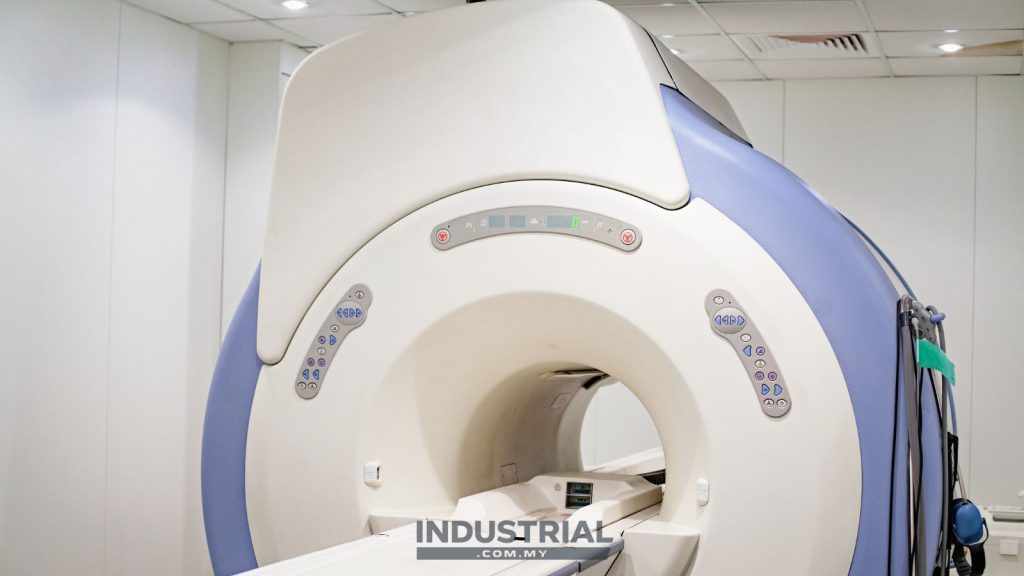
Magnetic resonance imaging machines are among the most demanding magnet applications in existence. A clinical MRI scanner uses superconducting electromagnets cooled to near absolute zero with liquid helium to generate extremely powerful and highly uniform magnetic fields, typically 1.5 to 3 Tesla for diagnostic imaging, compared to around 0.0001 Tesla for Earth’s own magnetic field. The exceptional field strength and homogeneity required for diagnostic quality imaging demands precision magnet engineering at a level far beyond any standard industrial application.
In the Malaysian healthcare context, this has practical implications for facility planning and equipment management. The powerful magnetic field of an MRI machine does not stop at the scanner room wall. It extends outward in a three-dimensional zone called the fringe field, and any ferromagnetic object, tools, medical equipment, gas cylinders, even cleaning trolleys, that enters this field without proper screening can be violently attracted to the magnet, creating serious safety hazards. Malaysian hospitals operating MRI suites must establish and strictly enforce controlled access zones mapped to the fringe field contours, and must ensure that all equipment brought near the scanner is either MRI-conditional or MRI-safe.
Beyond MRI, permanent magnets are used in a wide range of medical device applications in Malaysia: in the drive mechanisms of insulin pumps and implantable drug delivery devices, in cochlear implant processors, in magnetic dental implant retention systems, and in the encoded magnetic identification systems used in hospital patient management. For all these applications, the magnet grade, coating, dimensional tolerances and long-term stability under body-temperature conditions are tightly specified, and the supply chain must provide full material traceability and biocompatibility certification.
Factors That Degrade Magnet Performance in Malaysian Operations
Magnets do not maintain their performance indefinitely under all operating conditions. Understanding the degradation mechanisms helps operators maintain magnetic performance and identify when replacement is needed:
- Temperature, all magnet materials have maximum operating temperatures above which permanent demagnetisation occurs. Neodymium magnets exposed to temperatures above their rated maximum lose field strength that is not recovered when they cool down. In Malaysian factory environments with high ambient temperatures and proximity to heat-generating equipment, temperature management of installed magnets is important
- Mechanical shock and vibration, strong mechanical impacts can partially demagnetise permanent magnets, particularly the more brittle rare earth types. Magnets in high-vibration environments should be protected from direct impact and inspected periodically
- Corrosion, uncoated neodymium oxidises rapidly in Malaysia’s humid environment, eventually crumbling and losing structural integrity as well as magnetic performance. Appropriate coatings (nickel, epoxy, PTFE depending on the chemical environment) are essential for longevity in any exposed application
- Accumulated debris, magnet separators that are not cleaned regularly accumulate metal fines that reduce the gap between the magnet face and incoming product, degrading separation efficiency. Cleaning frequency should be based on measured metal loading of the product stream
Industrial Magnetic Products in Malaysia
For Malaysian manufacturing and engineering operations requiring industrial magnets, from magnetic separators and workholding systems to custom magnetic assemblies and sensing components, working with a specialist supplier who understands the range of available magnetic materials, can advise on correct specification for each application, and carries quality engineering products at competitive prices delivers better outcomes than general hardware procurement.
Recommended Supplier: Action Machinery, MalaysiaMagnet.com
Action Machinery offers all types of magnetic products related to machinery and engineering within the most nominal prices and a variety of categories. They are a leading supplier of industrial magnets in Malaysia with a team of experts focused on manufacturing quality engineering products. With a comprehensive range of magnetic products and engineering expertise across the main industrial magnet application categories, Action Machinery / MalaysiaMagnet.com is a reliable partner for Malaysian operations sourcing magnetic solutions for production, quality, safety and engineering applications.
Visit malaysiamagnet.com to explore their full range of industrial magnetic products and engineering solutions.
Specify for the Conditions, Not the Brochure
Industrial magnets are not a category where the cheapest option serves well for long. Underspecified magnets fail prematurely, degrade faster under real operating conditions than tested under ideal conditions, and in safety-critical applications like food processing metal separation, simply cannot be trusted to do their job reliably.
The correct approach is to specify the magnetic material for the actual operating temperature, chemical environment and field strength requirement; to size the magnet for the actual load with an appropriate safety margin; and to specify protective coatings and housing appropriate for the installation environment. Done correctly, industrial magnets are extremely reliable, long-life components. Done incorrectly, they are a recurring source of maintenance, product quality and safety problems.
- Industrial Plastic Sheets in Malaysia: A Complete Buyer’s Guide
- Bagging and Filling Systems in Malaysia: Which Technology Is Right for Your Product?
- Complete Guide to Carton Box Packaging for Malaysian Businesses
- Industrial Workbenches in Malaysia: How to Specify the Right Bench for Your Application

