
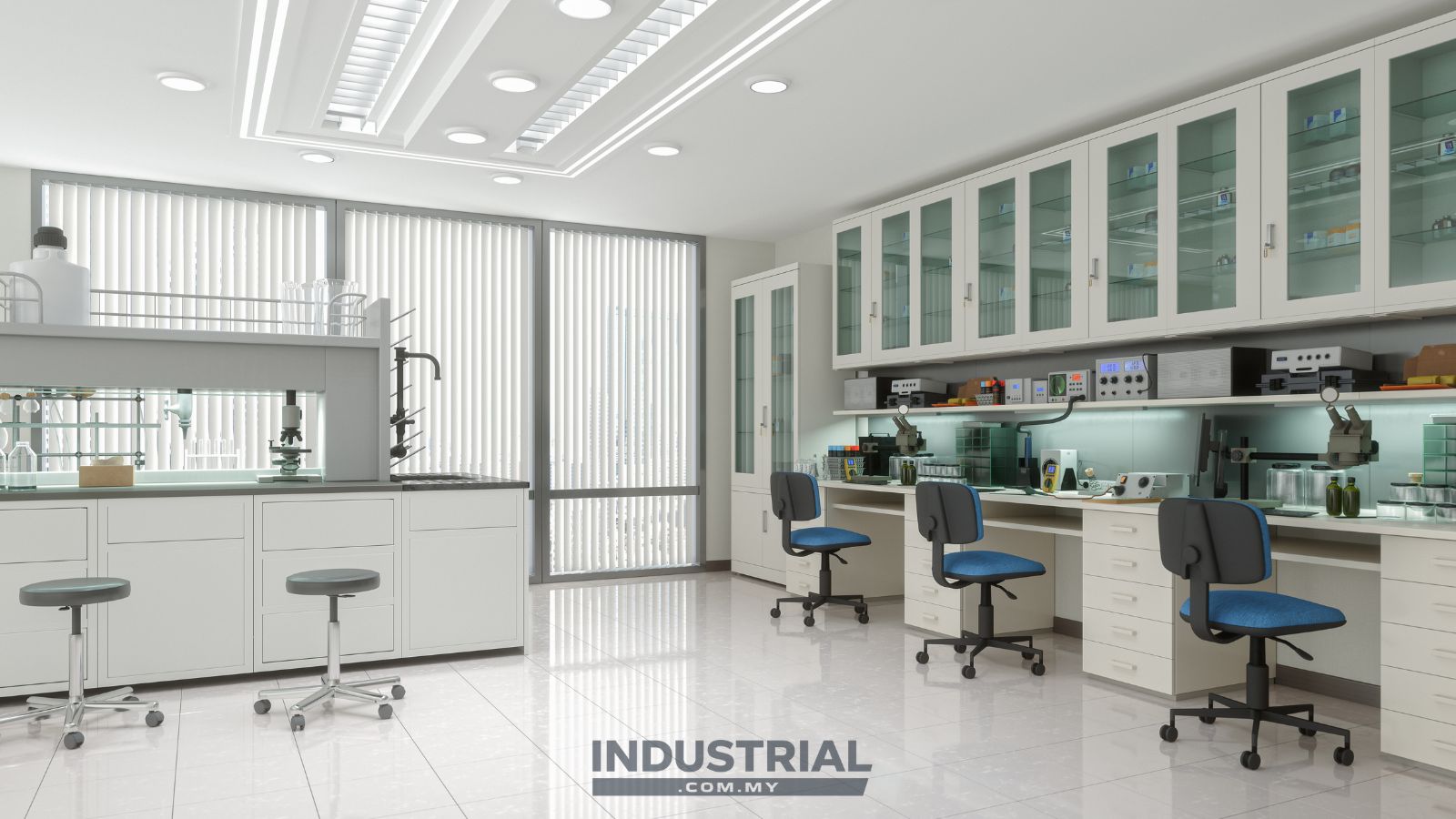
Laboratory furniture is a category where the gap between what looks adequate and what actually works can be wide, and where the consequences of specifying incorrectly are felt every single working day by the scientists, technicians and researchers who use the space. A lab bench that is the wrong height causes cumulative ergonomic strain. A worktop material that reacts with the chemicals being used creates both a safety hazard and a maintenance problem. A fume cupboard installed without proper airflow considerations protects nobody. And a storage system that does not match the actual workflow of the lab creates inefficiency that compounds quietly over months and years.
Malaysia’s laboratory sector has expanded significantly in recent years, driven by growth in university research, pharmaceutical manufacturing, semiconductor QC, medical device testing, food safety analysis, and the expanding network of public and private healthcare facilities. With that expansion has come demand for laboratory furniture that meets international standards for safety, durability and ergonomic design, not the compromise solutions that an earlier generation of Malaysian labs often had to accept.
Read on for a clear breakdown of what makes laboratory furniture perform, how ESD workstations work, what office furniture in technical settings actually needs, and how a custom furniture project is run from start to finish.
Laboratory Bench Fundamentals: What Determines Quality
A laboratory bench looks simple from the outside, a flat surface on a frame. But a well-specified lab bench is a precision piece of engineering that will be in daily use for fifteen to twenty years in a chemically aggressive, mechanically demanding environment. These are the elements that determine whether it performs that way.
Worktop Material Selection
The worktop is the most critical element of a laboratory bench and the one that most directly affects safety and functionality. The right material depends entirely on the specific chemical and physical conditions of the application. Phenolic resin (also known as Trespa or Klab) is the most common choice for general chemistry, it offers excellent resistance to a broad range of laboratory chemicals, is hard enough to resist abrasion and impact, and is thermally stable to around 135°C. Epoxy resin tops offer better chemical resistance in specialist applications. Stainless steel Grade 316 is the choice for biology, food science and pharmaceutical applications where cleanliness, sterilisability and resistance to disinfectants take priority. Ceramic is used in acid rooms and applications with extreme chemical exposure.
Frame Construction and Load Ratings
Laboratory bench frames in Malaysian facilities are overwhelmingly steel, either mild steel with powder coat or stainless steel for wet or corrosive environments. Frame gauge matters significantly for longevity and load-bearing performance: budget frames using thin-gauge steel will flex, vibrate and show structural fatigue within a few years of intensive laboratory use. Quality laboratory furniture manufacturers specify frame tube sections and weld quality that can carry uniform distributed loads of 250 to 350 kg per linear metre without deflection.
Reagent Shelves, Modular Storage and Service Rails
A laboratory bench without properly designed reagent storage is a bench that accumulates clutter, and clutter in a laboratory is both a safety hazard and a productivity drain. Reagent shelves mounted above the bench work surface, with appropriate lips to prevent containers from sliding off, are standard in any quality laboratory setup. Service rails running along the rear of the bench integrate power outlets, data points, gas taps and air lines in a way that keeps them accessible without taking up bench surface area. Modular underbench storage, drawers, cupboards, mobile pedestals, should be specified based on the actual storage requirements of the specific laboratory function, not just filled from a catalogue.
ESD Workbenches for Electronics and Precision Assembly
Electronics manufacturing, semiconductor testing, PCB assembly, precision instrument calibration and sensitive electronics repair all require workstation environments where electrostatic discharge (ESD) is controlled. The consequences of inadequate ESD protection are well documented, component damage is often latent, meaning the affected component continues to function until a premature field failure that is difficult to trace back to its root cause.
A complete ESD workstation system integrates:
- ESD-dissipative worktop laminate with measured surface resistance in the range 10^6 to 10^9 ohms, verified at installation and regularly retested
- Continuous ground cord connecting the worktop to a certified earth ground via a wrist strap snap connector and a resistance-monitored grounding point
- ESD-dissipative or conductive underbench storage, standard melamine-faced particleboard is not appropriate in an EPA (ESD Protected Area)
- ESD floor mat system coordinated with the worktop grounding scheme
- Regular resistance testing documentation, a requirement for most IPC-A-610 and JEDEC-compliant quality systems
Office Furniture in Technical and Industrial Environments
The administrative functions supporting Malaysian manufacturing and laboratory operations, production planning offices, quality management departments, engineering rooms, R&D centres, require office furniture that balances the professional appearance appropriate for a modern workplace with the durability and functionality needed in an industrial or technical environment.
Key considerations for office furniture in technical settings include workstation ergonomics (adjustable height desks are increasingly specified as organisations understand the productivity and health benefits), cable management designed for technical users with multiple monitors and devices, robust pedestals and filing systems for technical documentation, and durable, easy-to-clean surfaces that can handle the demands of an environment where technical and physical work often coexist.
The Custom Furniture Project Process
Standard catalogue furniture rarely fits a Malaysian laboratory or technical space optimally. Lab dimensions, column positions, existing MEP service drops, specific equipment to be accommodated, and the particular workflow of the team using the space all create requirements that catalogue solutions address imperfectly. A custom furniture project, properly scoped and managed, delivers a space that genuinely works.
The stages of a professional custom laboratory or office furniture project:
- Site survey and brief development, measuring the space precisely, understanding the services available (electrical, gas, water, data), clarifying the work activities and storage requirements, and documenting any constraints
- Design and layout development, producing dimensioned floor plans, elevation drawings and 3D renders that show the proposed furniture arrangement in context with the actual space
- Material and finish specification, selecting worktop materials, frame finishes, storage configurations and accessory components appropriate to the application
- Approval and fabrication, obtaining written client approval of the design before fabrication begins, with any changes documented as formal variations
- Delivery and installation, coordinating with the client’s operations to minimise disruption during installation, particularly for operating laboratories
- Commissioning and handover, verifying that all service connections are functional, that storage is correctly positioned, and that ESD systems (where applicable) are tested and documented
Laboratory Furniture and Custom Workstation Solutions in Malaysia
For Malaysian laboratories, electronics facilities, research centres and technical offices requiring furniture engineered to the specific demands of the application, whether from a proven range or fully custom-designed, working with a manufacturer who combines design capability with fabrication experience and a genuine understanding of the technical requirements delivers a substantially better outcome than sourcing from general furniture suppliers.
Recommended Manufacturer: Artsystem
Artsystem is a laboratory furniture manufacturer in Malaysia offering all kinds of office furniture, interior design consultancy, laboratory furniture, industrial workbench ESD and custom made furniture. With expertise spanning the full spectrum from laboratory bench specification and ESD workstation design through to office interior fitout and custom fabrication, Artsystem serves the diverse furniture and workspace requirements of Malaysian technical, research and industrial environments.
Visit artsystem.com.my to explore their laboratory furniture, ESD workstation and custom furniture solutions.

Design It for the Work, Not the Catalogue
Laboratory and technical furniture is an investment measured in decades, not years. The quality of the specification and fabrication determines whether that investment delivers a safe, productive, well-organised working environment for its entire lifespan, or generates a persistent series of maintenance issues, ergonomic complaints and workflow compromises.
Get the brief right before the design process begins. Specify worktop materials for the actual chemical and physical conditions of the application. Design storage around the real workflow, not a generic assumption. And commission ESD systems properly rather than assuming that the right materials alone are sufficient. The result will be a laboratory or technical workspace that your team can rely on.
- Industrial Magnets in Malaysia: A Complete Guide to Magnetic Products for Engineering and Manufacturing
- Panduan Lengkap Memilih Kotak Pembungkusan Berkualiti untuk Perniagaan Makanan di Malaysia
- Industrial Workbenches in Malaysia: How to Specify the Right Bench for Your Application
- Industrial Plastic Sheets in Malaysia: A Complete Buyer’s Guide

