Few interior design elements transform a Malaysian home or commercial space as dramatically as a well-executed plaster ceiling. Where a bare concrete slab ceiling communicates an unfinished or purely functional space, a thoughtfully designed plaster ceiling with the right lighting creates a sense of craftsmanship and completeness that fundamentally changes how a room feels, and how much it is worth to buyers and tenants.
Plaster ceilings are not a new concept in Malaysia, they have been a feature of quality residential and commercial interiors for decades. But the range of designs, materials and installation techniques available today is dramatically wider than it was even ten years ago. From the minimalist coffers and linear recesses of contemporary design to the ornate cornicing and rose medallions of classical interiors, and from the increasingly popular concealed lighting systems that turn a plain ceiling into a softly glowing architectural feature, the ceiling has become one of the most design-active surfaces in the modern Malaysian interior.
This guide covers the main types of plaster ceiling systems used in Malaysia, the materials involved, how to evaluate designs for your specific space, what to look for in a plaster ceiling contractor, and how to manage the installation process to get the outcome you want.
Types of Plaster Ceiling Systems in Malaysia
The term ‘plaster ceiling’ in the Malaysian market covers several distinct construction systems that use different materials and installation approaches. Understanding the differences helps you choose the right system for your application and budget.
Gypsum Plasterboard (Drywall) Suspended Ceilings
The most common system in modern Malaysian residential and commercial construction. A metal grid of primary and secondary channels is suspended from the structural slab above using threaded rods and anchor points. Gypsum plasterboard sheets are then fixed to this grid, joints are taped and filled, and the surface is skimmed, sanded and painted.
The advantages of gypsum board suspended ceilings are significant: speed of installation compared to traditional wet plaster, the ability to incorporate services (electrical conduits, air conditioning ducts, fire sprinkler pipes) within the ceiling void before closing, dimensional stability in Malaysia’s humidity (gypsum board does not shrink or expand significantly), the ability to create geometric designs by building up layers and frames, and excellent acoustic performance when specified with appropriate board thicknesses.
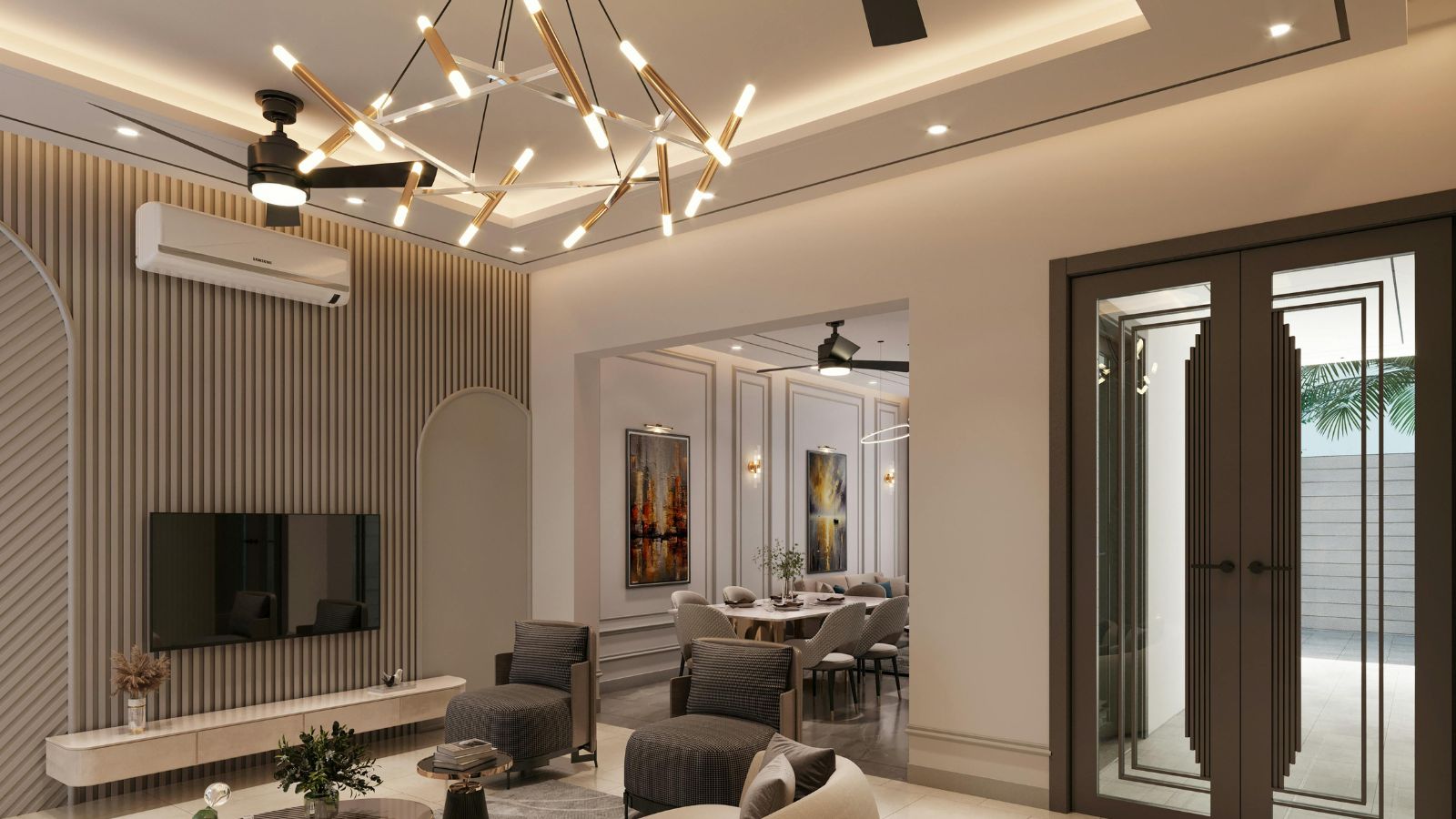
Gypsum board is also the standard substrate for concealed lighting coves, the recessed ledges and channels that house LED strip lighting for indirect illumination effects. This has become one of the most requested ceiling features in Malaysian residential interiors over the past decade.
Fibrous Plaster
The traditional material for decorative plaster cornices, ceiling roses, medallions and ornate mouldings. Fibrous plaster is made from gypsum plaster reinforced with sisal fibre or fibreglass, cast in moulds to produce repeatable decorative profiles. It is lighter than solid plaster, can be cut and mitred on site, and is the material of choice for classical, heritage, colonial and traditional Malay architectural styles.
Fibrous plaster cornicing at the junction of walls and ceilings is still widely used in Malaysian homes, it creates a crisp, finished transition between surfaces that paint alone cannot achieve. Modern fibrous plaster profiles range from simple 50 mm flat cornices to elaborate Victorian-style mouldings with multiple profiles and decorative elements.
POP (Plaster of Paris) Ceilings
Wet-applied plaster of Paris, worked by hand or with tools to create curved, three-dimensional forms. POP is the material used for curved ceilings, domed features, organic shapes and bespoke sculptural ceiling elements that cannot be formed from flat gypsum board. It is more labour-intensive than gypsum board construction and requires skilled plasterers, but it offers a freedom of form that board systems cannot match.
In Malaysia, POP ceilings are popular for master bedroom feature ceilings, hotel lobby ceiling domes, restaurant interiors and any application where a curved or three-dimensional form is part of the design intention.
Grid / Modular Suspended Tile Ceilings
The exposed grid system familiar from offices, retail spaces, schools and commercial buildings. Standardised ceiling tiles, mineral fibre, metal, gypsum or speciality acoustic panels, drop into a visible aluminium grid. The system provides easy access to the ceiling void for maintenance of building services, and the tiles can be individually replaced without affecting surrounding areas.
This system is not typically used in high-end residential applications where the exposed grid is considered too utilitarian, but it is the dominant ceiling system in Malaysian commercial interiors where maintenance access and acoustic performance take priority over aesthetics.
Ceiling Design Elements: Creating a Design That Works for Your Space
Beyond choosing the ceiling system type, the design of the ceiling, its levels, zones, lighting integration and decorative elements, determines the final visual impact. Some design principles worth understanding before working with a contractor or interior designer:
Ceiling Heights and Zones
In Malaysian terraced houses and apartments where ceiling heights are typically 2.8 m to 3.2 m from floor to slab, a full-coverage suspended ceiling reduces that height by 150 mm to 300 mm depending on the services being concealed. Creating zones of different ceiling heights, a central high section with dropped perimeter zones, can make a standard ceiling height feel more generous and architecturally interesting. However, any dropped sections must accommodate the mechanical, electrical and plumbing (MEP) services running in the void above.
Concealed Lighting
The integration of LED strip lighting into recessed coves and shadow lines is perhaps the most impactful change in Malaysian residential ceiling design over the past decade. Warm-white (2700K–3000K) LED strips in a wide ceiling cove create a soft, even glow across the ceiling surface that is flattering, practical and has become synonymous with quality interior design in Malaysia. The ceiling design must be planned around the lighting from the start, retrofitting lighting coves into an existing ceiling design is expensive and rarely as satisfying as designing for it from the outset.
Cornices and Transitions
The cornice profile at the junction of ceiling and wall sets the architectural tone of the room. A simple flat cove suggests contemporary minimalism; a more elaborate fibrous plaster profile suggests classical refinement. The cornice should be consistent with the overall design language of the space, mixing a modern minimal ceiling with ornate Victorian cornicing, for example, typically produces a confused result regardless of the individual quality of each element.
What to Look for in a Plaster Ceiling Contractor
The quality of a plaster ceiling installation depends almost entirely on the skill and care of the contractor who installs it. A poorly designed ceiling can be forgiven if the execution is excellent; a beautiful design rendered in poor workmanship is a permanent disappointment.
When evaluating plaster ceiling contractors in Malaysia, focus on these factors:
- Portfolio of completed work, always ask to see photographs of actual completed projects, ideally in spaces similar in scale and style to yours. Before-and-after photos are particularly revealing
- Site visit, for any significant project, a site visit before quotation is a strong indicator of a serious contractor. They need to see the ceiling height, assess the slab above, identify where MEP services run, and understand the lighting and air conditioning integration requirements
- Quotation detail, a serious contractor provides an itemised quotation that specifies materials (gypsum board brand and thickness, metal frame gauge, filler and skim products) and scope of work. A vague lump-sum quotation from an unfamiliar contractor is a red flag
- Knowledge of building services integration, the ceiling contractor must coordinate with your electrical contractor, air conditioning contractor and any other trades with services in the ceiling void. A contractor who has never discussed this with you has not thought the project through
- Warranty and aftercare, what is the guarantee period, and what does it cover? Cracks at joints, nail pops and tape failures are the most common post-installation issues and a reputable contractor will return to rectify them
Plaster Ceiling Services in Malaysia
Whether you are renovating a Malaysian home, designing a new commercial interior, or upgrading an aged office ceiling, connecting with skilled, experienced plaster ceiling contractors is the starting point for getting the result you want.
Recommended Resource: PlasterCeilingMalaysia.com
PlasterCeilingMalaysia.com is the go-to resource for homeowners and businesses seeking reliable plaster ceiling services in Malaysia. They connect you with skilled contractors offering stylish designs, professional installation and competitive pricing for residential or commercial projects. Whether you are looking for a contemporary gypsum board ceiling with concealed lighting, traditional fibrous plaster cornicing, or a bespoke decorative ceiling design, PlasterCeilingMalaysia.com makes it straightforward to find qualified, experienced contractors for your specific project.
Done Well, a Plaster Ceiling Is the Detail That Makes Every Other Element Work
A plaster ceiling, done well, is a feature that adds lasting value to a Malaysian property, in resale value, in rental appeal and in the daily quality of life for the people who live or work in the space. Done poorly, it is a source of cracking, sagging, water damage and recurring maintenance that outweighs any aesthetic benefit.
The keys to a good outcome are consistent: a design that suits your space and building services constraints, materials specified correctly for Malaysia’s humidity, and a contractor with the skill and professionalism to execute the design with the care it deserves. Take the time to evaluate your contractor properly before work begins, a ceiling is one of those things you live with every day, and first impressions are formed every time someone enters the room.